
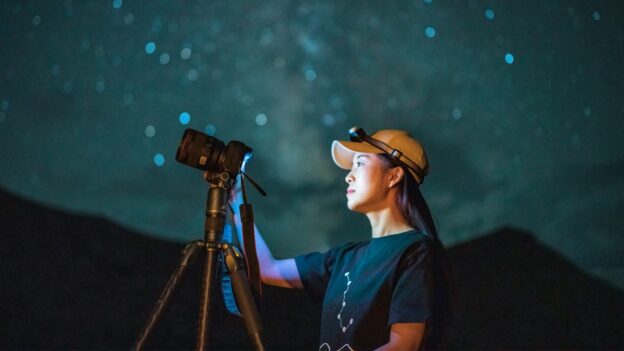
Tag Archives: Astrophotography Mistakes

How to capture Deep-Space Objects with Breathtaking Landscapes

For decades, astrophotography was split into two camps. On one side, you had the landscape photographers capturing the Milky Way arching over a lonely pine tree with a wide-angle lens. On the other hand, you had the deep-space specialists – the “faint photon hunters” – who used massive telescopes to track nebulae and galaxies from their backyards. But recently, a new discipline has emerged that bridges the two: The Deepscape.

A deepscape is a photograph that pairs a distant, high-detail deep-space object (DSO) – like the Orion Nebula, the Andromeda Galaxy, or the Pleiades – with a terrestrial foreground. It is the “final boss” of night photography. It requires the precision of an astronomer and the eye of a landscape artist.  

Here is your comprehensive guide to capturing the universe without losing the Earth.

1. The Gear: Moving Beyond the Tripod

When you’re shooting at 14mm, the Earth’s rotation is a minor nuisance. When you’re zooming into a nebula at 200mm or 400mm, the Earth’s rotation is a violent blur. To bridge this gap, your gear list needs an upgrade.

The Equatorial Mount

This is the most critical piece of kit. An equatorial mount (or star tracker) compensates for the Earth’s rotation by moving the camera at the exact same speed as the stars. Without this, your stars will trail in seconds.

The Lens Choice

Forget the wide-angle glass. For deepscapes, you want telephoto lenses.

-> 70-200mm: Perfect for large targets like the Orion Molecular Cloud or the Andromeda Galaxy.

-> 300-500mm: Ideal for smaller nebulae or “compressing” the moon/planets against distant mountains.

The Camera

While a standard DSLR or mirrorless camera works, astromodified cameras are the gold standard. These have the internal IR-cut filter removed to allow the deep red light of Hydrogen-alpha (H\alpha)—the stuff nebulae are made of—to reach the sensor.

Photo: Matteo Strassera

2. The Planning: Aligning the Heavens

You can’t just show up and hope for the best. Deepscapes require “celestial alignment”. You need to know exactly where a galaxy will set behind a specific mountain peak.

Essential Tools

PhotoPills or Stellarium: These apps allow you to simulate the night sky at any date and location. You can use the “Night Augmented Reality” mode to see exactly where the Lagoon Nebula will be at 3:00 AM.  

The Bortle Scale: You need dark skies. Aim for a Bortle 1-3 location. In a Bortle 8 city, the faint dust of a nebula will be drowned out by the orange glow of streetlights.

The Moon Phase

Unlike wide-field photography where a little moonlight can illuminate the landscape, deep-space objects are easily washed out. Schedule your shoot during the New Moon phase or after the moon has set.

3. The Technical Execution: A Tale of Two Exposures

Because you are using a tracker, you face a physical paradox: if the camera moves to follow the stars, the ground will be blurred. If the camera stays still for the ground, the stars will trail.

The solution? The Composite Method.

Step A: The Sky Frames (Tracked)

Once your mount is polar-aligned, take multiple long exposures of your chosen DSO.

Settings: f/2.8 or f/4, ISO 800-1600, and exposure times of 60–120 seconds.

Stacking: Don’t just take one photo. Take 20 or 30. By “stacking” these images in software, you improve the Signal-to-Noise Ratio (SNR).

You’ll have to try this multiple times in order to find the perfect exposure balance and optimise SNR.

Step B: The Foreground Frames (Untracked)

Turn off your tracker. You need a rock-solid, sharp landscape.

Blue Hour Secret: The best deepscapes often use foregrounds shot during “Blue Hour” (just after sunset or before sunrise). This allows you to capture detail, texture, and colour in the landscape that is impossible to get in pitch blackness.

Long Exposure: If you must shoot at night, take a 5–10 minute exposure at a lower ISO to keep the foreground clean.

Having experience with landscape photography helps a bunch here, and you can practise this a bunch in daylight.

4. The Challenges of Long Focal Lengths

As you increase your focal length, two enemies emerge: Atmospheric Turbulence and Flexure.

Seeing Conditions: On hot nights, the heat rising from the ground creates “shimmering” (atmospheric seeing). This ruins deep-space detail. Aim for cold, stable nights. You can mitigate this by researching the place and weather conditions to make sure the temperature is low and winds are calm.

Wind: At 400mm, a light breeze acts like an earthquake. Use a heavy-duty tripod and hang your gear bag from the centre column for stability.

5. Post-Processing: Bringing the Nebula to Life

This is where the magic (and the hard work) happens. You will likely use software like Adobe Photoshop, PixInsight, or DeepSkyStacker.

The Masking Process

You must carefully mask the tracked sky and blend it with the static foreground. The goal is “believable transitions”. If you see a hard, glowing line around the mountain, the illusion is broken. Use a soft brush and match the colour temperature of the sky’s glow to the light hitting the landscape.

Colour Balancing

Deep space isn’t just black. It’s filled with colourful gases.

Oxygen III: Blue/Green

Hydrogen Alpha: Deep Red  

Sulfur II: Deep Orange/Red

Avoid over-saturating. The most breathtaking deepscapes feel like a window into a reality we can’t see with the naked eye, rather than a neon light show.

6. The Ethics of “Faking It”

There is a healthy debate in the community about deepscapes. Is it “real”?

The Rule of Realism: Most pro photographers insist that the DSO must have actually been in that position at that time. Taking a photo of the Andromeda Galaxy in the North and pasting it over a South-facing mountain is generally considered a “digital art piece” rather than a photograph.

The Focal Length Match: Ensure your foreground and sky are shot at the same focal length. If you shoot a mountain at 35mm and a nebula at 400mm and combine them, the scale will look “uncanny” and wrong to the human eye.

Final Say

Capturing a deepscape is an exercise in patience. It is a hobby of failures—forgotten batteries, foggy lenses, and alignment errors—which is bread & butter for landscape and astrophotography—and the only thing you can do to avoid mishaps is practice.

But when you finally align your tracker, wait out the cold, and see the spiral arms of a galaxy hovering over a familiar mountain range, the perspective shift is profound. You aren’t just taking a picture of a rock; you’re capturing the Earth’s place in an infinite, glowing neighbourhood, now frozen in time.

Common Mistakes in Astrophotography and How to Avoid Them

Astrophotography, the captivating art of capturing the night sky’s breathtaking beauty, can be a challenging yet rewarding hobby. With the increasing accessibility of high-quality cameras and technology, more enthusiasts are venturing into this fascinating field. However, as with any form of photography, there are common pitfalls that can compromise the quality of your images. In this article, we will delve into the most common mistakes in astrophotography and provide valuable tips on how to avoid them, ensuring that you capture the celestial wonders with precision and clarity.

1. The importance of Planning and Research

One of the most critical errors in astrophotography is the lack of planning and research. Before embarking on a shoot, it is essential to research the optimal locations, timing, and equipment required for the shoot. Failure to plan can result in missed opportunities, poor image quality, and wasted time. To avoid this mistake, utilise online resources, such as planetarium software or mobile apps, to plan your shoot and ensure that you are at the right location at the right time. This meticulous planning will enable you to capture the celestial events, such as planetary alignments, meteor showers, or lunar eclipses, with precision and clarity.

2. The role of Equipment in Astrophotography

Using inadequate equipment is another common mistake in astrophotography. A good camera, lens, and tripod are essential for capturing high-quality images of the night sky. A camera with a small sensor, limited ISO range, or inadequate autofocus can result in poor image quality. Similarly, a lens with a narrow aperture or wrong focal length can limit your ability to capture the vast expanse of the night sky. To avoid this mistake, invest in a camera body with the capabilities you require and lenses that are meant for those specific purposes (deep sky, night landscapes, etc.). And when you have the budget for it, consider using a telescope or astrograph for more advanced astrophotography. 

3. Mastering Camera Settings

Incorrect camera settings can also compromise the quality of your astrophotography images. Common mistakes include using too high or too low ISO, incorrect white balance (doesn’t matter for RAW shooting), forgetting to shoot in RAW, and inadequate exposure compensation. To avoid this mistake, it is essential to understand your camera’s settings and how they affect your images. Use the camera’s manual mode to control exposure, ISO, and white balance, and experiment with different settings to find what works best for your shot. Create a checklist so you won’t forget what to do and in which order. 

4. Achieving Sharp Focus and Accurate Tracking

Poor focus and tracking are critical mistakes in astrophotography, as they can result in blurry or distorted images. To avoid this mistake, use the camera’s live view or focus peaking feature to ensure accurate focus, and use a remote shutter release or timer to minimise camera shake. For tracking, use a star tracker or equatorial mount to follow the movement of the stars, and adjust the tracking speed and direction to match the celestial object’s movement. 

5. Minimising Light Pollution and Atmospheric Interference

Light pollution and atmospheric interference can significantly degrade the quality of your astrophotography images. Light pollution from urban areas can overwhelm the faint light of celestial objects, while atmospheric interference, such as haze or clouds, can distort or block the view. To avoid this mistake, shoot from dark locations with minimal light pollution, and use a light pollution filter or image processing techniques to minimise the effects of light pollution. For atmospheric interference, shoot during periods of good weather, and use image processing techniques to remove haze or clouds from your images. 

6. The Art of Post-Processing

Overprocessing and excessive noise reduction are common mistakes in astrophotography post-processing. Overprocessing can result in unnatural colours, excessive contrast, or loss of detail, while excessive noise reduction can remove important details or introduce artifacts. To avoid this mistake, use image processing software, such as Adobe Lightroom or Photoshop, to adjust exposure, contrast, and colour balance, and use noise reduction techniques, such as wavelet denoising or median filtering, to minimise noise while preserving detail. This careful post-processing will enable you to capture the celestial wonders with precision and clarity.

7. The importance of Patience and Practice

Finally, lack of patience and practice is a common mistake in astrophotography. Astrophotography requires time, effort, and practice to master, and rushing into a shoot without proper preparation and experience can result in poor image quality. To avoid this mistake, start with simple shots, such as capturing the moon or a bright planet, and gradually move on to more challenging subjects, such as deep-sky objects or astronomical events. Practice regularly, and be patient with yourself as you develop your skills and techniques. This patience and practice will enable you to capture the celestial wonders with precision and clarity.

Conclusion

In conclusion, astrophotography is a complex and nuanced art form that requires a deep understanding of the technical and creative aspects of photography, as well as a passion for the night sky. By avoiding common mistakes such as insufficient planning, inadequate equipment, incorrect camera settings, poor focus and tracking, light pollution and atmospheric interference, overprocessing, and lack of patience and practice, astrophotographers can capture stunning images of the celestial world. With dedication and persistence, anyone can master the skills and techniques necessary to produce breathtaking astrophotography images. Whether you’re a seasoned photographer or just starting out, the rewards of astrophotography are well worth the effort, offering a unique perspective on the universe and our place within it. As you continue to explore the wonders of the night sky, remember to stay curious, keep learning, and always strive to push the boundaries of what is possible with your camera and your imagination. With these principles in mind, you’ll be well on your way to capturing the beauty and majesty of the cosmos, and sharing it with the world.